Musical Terms
In order to get to grips with recognising the notes on the musical stave, there are a number of musical terms that you need to be familiar with. I've summarised them in the picture and jotted down brief explanations below.
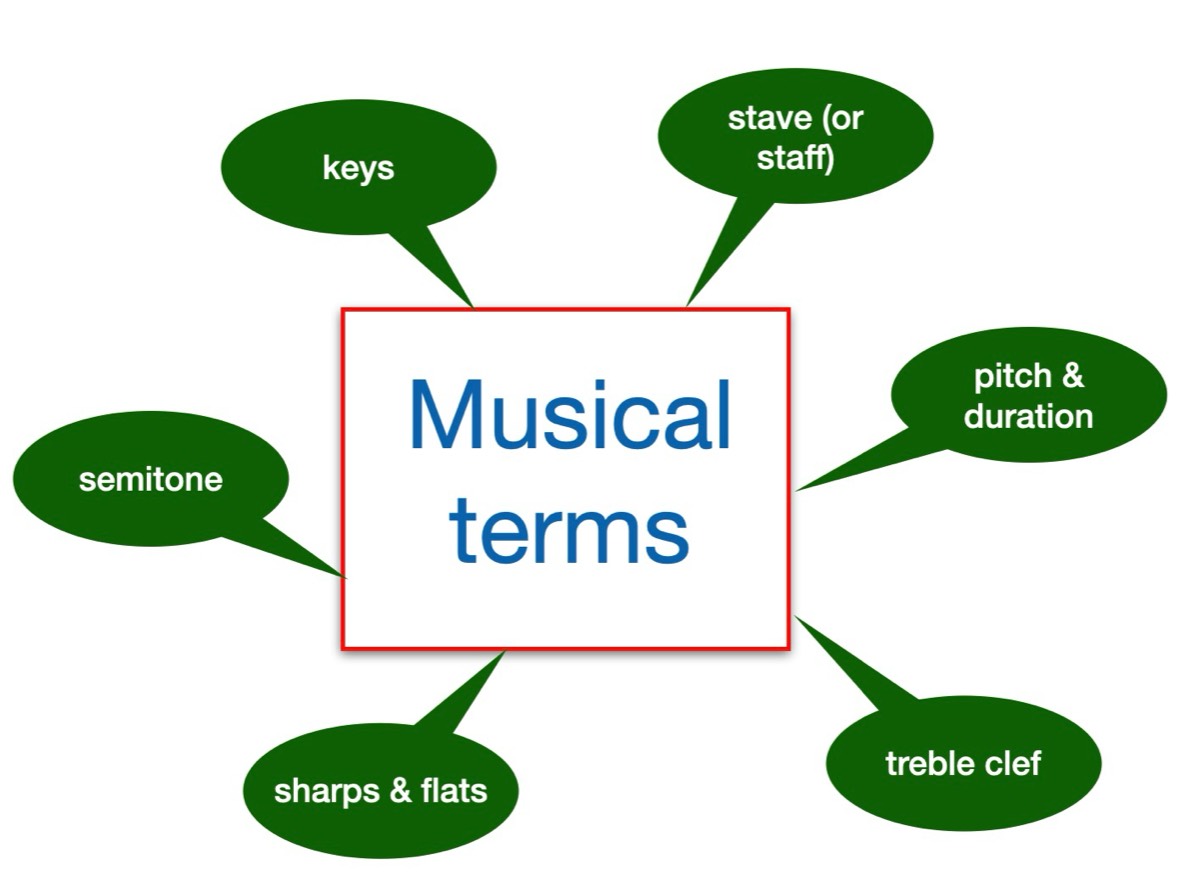
Some important musical terms
The Stave (aka Staff)
In its simplest form, modern musical notation is based on a structure of five horizontal lines called the stave (or staff in the USA).
In its simplest form, modern musical notation is based on a structure of five horizontal lines called the stave (or staff in the USA).

The 5-line stave
Pitch
The pitch of a note (how high or low it is) is shown by the where note’s head is positioned on the stave. The note shown here is high pitched because the note head is near the top of the stave.
The duration of a note (how long it is held) is shown by the how the note is written. This is not covered here.

This note, 'e', has a high pitch.
The Treble Clef
Low pitched musical instruments have their own notation and for these instruments the stave starts with a bass clef (written 𝄢). Whistles and other higher-pitched instruments use the treble clef and this is the notation I’m covering here.
The bass clef is used for low pitched instruments and also for the left hand of piano music.
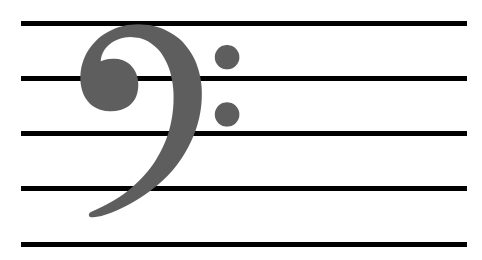
The bass clef is used for low pitched instruments and also for the left hand of piano music.

A stave with a treble clef—the notation used with whistle music
Sharps, Flats and Semitones
Sharps (written #) and flats (written♭) are written immediately before a note to indicate that it is to be raised (with a sharp) or lowered (with a flat) by one semitone. In whistle music, flats are rarely used so I'll focus just on sharps.
So, what's a semitone? On a piano keyboard, an interval of a semitone is a single step from one note to the next note, regardless of whether it is black or white. A 'tone' is an interval of two semitones.
For many tunes, one or more particular notes are always played with a sharp throughout the piece. To avoid having to write this on to the stave every time these notes crop up in the tune, this is shown on the stave at the beginning of each line of music.
The number of sharps (or flats) that a tune contains is what tells you the ‘key’ of the tune. Keys are explained below.

The note c sharp
Keys
The most common keys in traditional music are D and G (and sometimes the key of A is used). All of these keys contain sharps (i.e. no flats). The number and placement of the sharps tells you what key the tune is written in:
* The key of G has one sharp, F#
* The key of D has two sharps, F# and C#
* The key of A has three sharps, F#, C# and G#
Naturals, ♮
If you are playing a whistle that is in the key of D, normal fingering will automatically play the two sharps, F# and C#. Occasionally, however, for a particular note the tune will require you to play a straight c rather than c#. In this situation, the note in question will have a 'natural' symbol placed immediately before it.
Inserting the natural symbol has the effect of cancelling the sharp indicated for that note at the beginning of the line.
A 'natural' symbol looks like this: ♮
The note 'c natural is shown opposite.
The note 'c natural is shown opposite.
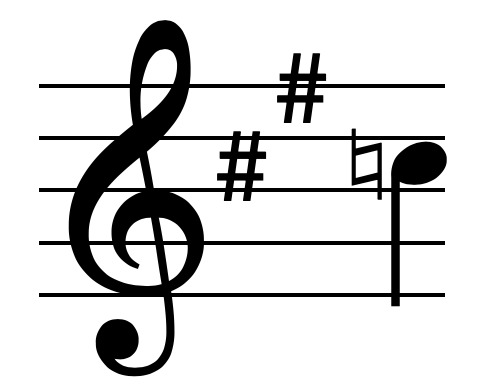

This tune has two sharps (F# and C#)
and so is in the key of D.
What, there's more?!
This quick tour of musical terms should get you started but there is still quite a lot to learn about musical notation that I haven't covered. If you want to find out more, click the link below (from the Musicnotes website). This resource extends some of the topics I've covered and explains a few extra ideas.
The key themes that you'll find there are:
* notes on the treble and bass clef
* note duration/note values
* dotted notes
* time signatures
* tones, semitones and scales
* sharps, flats and naturals
* key signatures
https://www.musicnotes.com/now/tips/how-to-read-sheet-music/
Direct link to the Learn the Whistle page.
